

Whose family stories get to exist?
When using AI is called cheating, the real question is who gets shut out of the historical record.

Welcome back to Chronicle Makers. I'm Denyse, and I help family historians research and write, using AI to do both better and faster. If you love what you find here, share it with a friend. All my previous posts and newsletters are archived here.
When I volunteered at a genealogy society in the 2010s, families would bring in boxes. Newspaper clippings. Records printed from Ancestry. Handwritten notes. Family trees. Backed-up software on disks from programs nobody ran anymore.
The president of the society would look through them. Then she’d throw them out.
Her reasoning was practical. If the family didn’t care enough to compile it into something useful, she wasn’t going to do it. None of us were. We were all swamped with our own research, our own piles, our own unfinished stories. We didn’t have time for a stranger’s life work.
I understood her reasoning. It still devastated me.
These boxes in the dumpster were the end of twenty years of someone’s work. They had done exactly what they were told: exhaustive research, saved carefully. And it ended in a trash can because the family couldn’t figure out what any of it meant.
It doesn’t have to be that way anymore.
We can turn those boxes into stories families actually keep. We can finish what those researchers started before anyone else has to make that decision about their boxes.
And right now there are people trying to stop that from happening.
They are calling it plagiarism
There are people in our community who cannot type for more than a few minutes at a time. Hands that shake. Eyes that tire. Injuries that changed how their brain organizes thoughts. They have decades of research. They know things about their ancestors that no one else alive knows. They drove to courthouses. They read microfilm until their eyes burned. They tracked down cousins and pieced together timelines from church records and tax rolls.
They did the work. They have the story. They use AI to help them write.
Some in the genealogy world would call that plagiarism.
I need you to sit with that for a second. They did four decades of original research. Their bodies or their circumstances just won’t let them get it on the page without help. And someone wants to tell them their finished chronicle doesn’t count because of the tool they used to get it there.
This isn’t about AI
Let me be direct about what’s happening.
When someone calls AI-assisted writing plagiarism or cheating or the newly coined “cognitive offloading”, they are making a claim about who deserves to have their family stories exist in the world.
They are saying the 55-year-old woman with dyslexia who spent her whole life avoiding writing should keep avoiding it.
They are saying the veteran with a brain injury whose thoughts come faster than his fingers can capture them should just keep those thoughts in his head.
They are saying the immigrant whose English is her third language but whose family story spans three continents should wait until her prose meets someone else’s standard.
They are saying the 72-year-old whose cognitive decline means she needs help organizing her memories into a narrative should let those memories die with her.
That is not a position on technology. That is a position on whose stories matter.
And here is the part nobody says out loud: most people in the world are not capable writers. That is not their fault. It never was. Writing is a skill that takes years to develop (unless you were one of the lucky ones born with that ability) and most people spent those years doing something else — raising families, building careers, serving their country, farming their land. They did not fail to become writers. They just became something other than writers. Their stories are not less real for it.
The tools are not the point
A woodworker who uses an electric powered planer is still a woodworker. Nobody unwraps a hand-crafted cutting board at Christmas and says ew, a planer touched this. They run their hand across the surface. They feel the work. They keep it for generations.
A quilter who uses a sewing machine is still a quilter. The machine allows different techniques. It allows more quilts and creativity in the design. The quilts still go to the grandchildren.
Humans have always embraced technology to reach their goals. That is not a compromise. That is the whole story of making things.
Calling AI-assisted writing plagiarism is like calling a wheelchair cheating at mobility. The person still has to get where they’re going. The tool removes the barrier that had nothing to do with the destination.
The elitism people are ashamed to name
The people making the plagiarism argument are almost always excellent writers themselves. They have advanced degrees. They’ve published. They’ve built careers on their ability to put words together.
So when they say “just write it yourself”, they’re saying it from a place of privilege where writing comes easily to them. They have never stared at a blank page knowing exactly what they want to say but having no idea how to structure it. They have never spent three hours on two paragraphs and deleted both because they sounded wrong.
For them, writing is a natural extension of thinking. It just happens. They enjoy the process. For millions of people, it is a huge wall between what they know and what their family will ever read.
The researchers sitting on the most work are often the ones with the least time left. They did exactly what they were told. Exhaustive documentation. Thousands of people. Decades of work in boxes and binders. Some are managing health challenges that make long projects harder every year. Some are watching their own memory change. Some are racing a clock they didn’t set.
AI is the first tool that can actually help them finish. Not learn a new system. Not take another webinar. Finish.
What I know about urgency
I know this from the inside.
Fifteen years ago I was diagnosed with cancer. Every three to six months I go back for tests. Death isn’t abstract for me. It sits with me every freaking day. AI helped me finish things I wasn’t sure I’d have time to finish.
So if it sounds like I am taking these attacks against AI use personally, I absolutely am.
When I first tried AI for family stories, I didn’t see a shortcut. I saw a finish line. I had the same piles everyone else had. I understood exactly what it felt like to have decades of research and nothing your family could read. When I saw what was possible I kept working at it. Tested it. Refined it. Built a method around it.
That became the Chronicle Method. We have now dozens of writers creating them. By July 4th — America’s 250th birthday — we are aiming for 250 chronicles.
Dozens of chronicles have been written that didn’t exist before. Not indexed in a database. Not generated by a genealogy platform. Written, personalized, and shared with love.
AI doesn’t just make finishing faster. For some people it makes finishing possible at all.
What AI actually does
Let me describe what happens when someone in our community uses AI to write their family story.
They bring the research. They bring the records. They bring the family knowledge that exists nowhere else on earth. They bring every decision about what matters, what to include, what their ancestor’s life meant.
The AI helps them organize those thoughts. It suggests ways to structure a narrative. It helps them find words when the right word won’t come. It catches grammar that they never learned or forgot decades ago.
The person still decides what the story is. The person still decides what’s true. The person still brings everything that makes the story theirs.
Tell me which part of that is plagiarism.
The stories waiting to be written
I think about the people in our community right now who have boxes of letters they haven’t been able to get through. The handwriting. The volume. The not knowing where to start. People who tried to write the story, got three pages in, decided it sounded wrong, and stopped. People who told me they just weren’t writers and maybe they should accept that.
People who have been carrying their family’s story for decades and just need a way in.
That is who this is for. Not someday. Now. Before the boxes end up in someone else’s trash can. Before the person who knows the story is no longer here to tell it.
The machinery being built
The same people who visit Salem today, horrified by what happened there, are building similar machinery now. The accusation is different. The apparatus is the same.
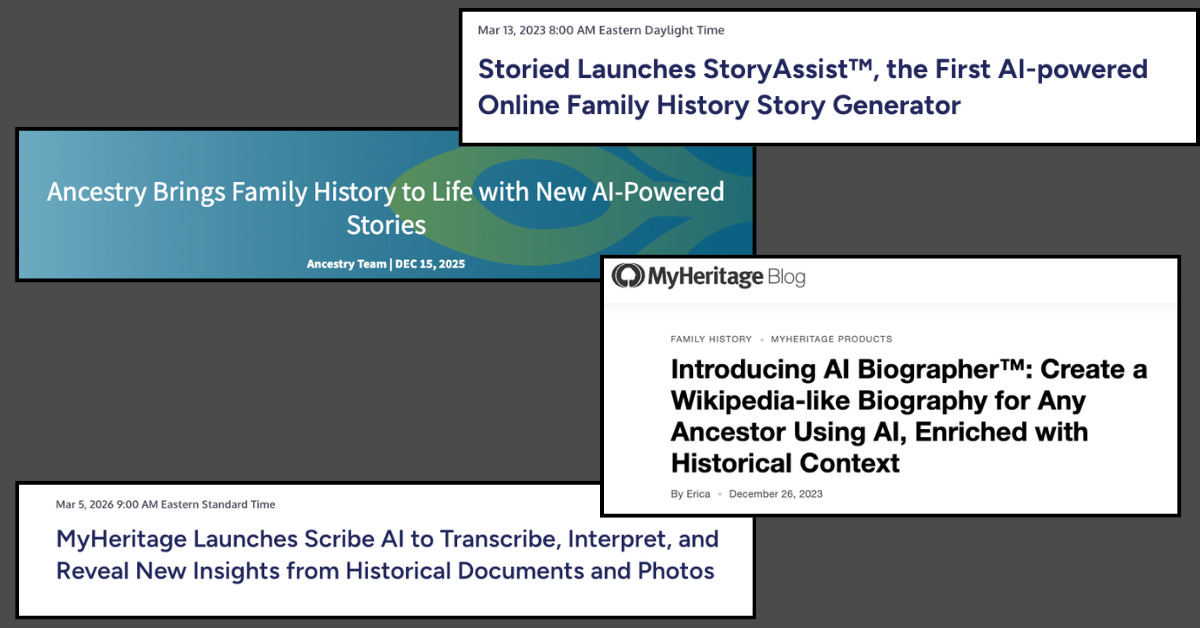
Certification programs. Governance councils. Disclosure requirements for individuals, while corporations generate AI stories from your family data with no oversight, no consent, and no recourse. The genealogy platforms have already published a version of your family’s story. You didn’t authorize it. You can’t verify all facts they used to generate it. You can’t take it down or correct it.
The standard right now is: It is acceptable for a corporation to profit from your research by generating AI content from your research and uploads. It is controversial for you to use AI to write your own story.
The Victorian era had medical examinations designed to confirm women’s purity before marriage. The examinations were scientifically useless. They produced false positives. They destroyed reputations and ruined lives. But the standards were upheld. The authorities felt they were protecting something important.
Ask yourself what the AI governance and disclosure apparatus is actually protecting and helping. It looks like corporations to me. It certainly not the 71-year-old woman who wants to write about what matters.
It’s not about standards. It’s about whose ancestors get remembered.
A question worth asking
Before you accept someone else’s standard for how your family story should be written, ask whose stories disappear if we make the tool off-limits.
Not mine. I can write. I’ve published books. I’ll be fine either way.
Not the people making the plagiarism argument. They can write too.
The stories that disappear belong to people who never had the privilege of easy writing. People with disabilities. People with limited or low quality education. People whose first language isn’t English. People whose age has made what was once easy now hard. People who simply never learned to write well because life took them somewhere else — and that was the right choice for the life they were living.
Those are the people with family stories that have never been written down. Those are the stories the world has never heard. Those are the exact stories family history exists to preserve.
And now, for the first time, those people have a tool that lets them get their stories out of their heads and into something their children and grandchildren can hold.
Calling that cheating or “cognitive offloading” or plagiarism isn’t protecting writing standards. It’s deciding which people get to contribute to the historical record. It always was.
What I believe
Your story matters more than the tools you use.
The person whose hands shake deserves to finish their chronicle. The woman with dyslexia has as much right to publish as the woman with a Masters in English. The veteran whose injury changed his writing ability didn’t lose his story when he lost his fluency. A finished chronicle that used AI is worth infinitely more than a perfect sentence that exists only in someone’s head.
You get to use the tools you want to use. You get to say what good looks like. Your standard is yours to meet for your personal work.
The woodworker knows when the table is right. The quilter knows when the quilt is finished. You know when your family’s story is done. That is not a lowered standard. That is sovereignty over your own work.
The boxes your family left behind don’t have to end up in a trash can. The research you have spent years collecting doesn’t have to wait for someone else to decide what it’s worth.
Use whatever tool helps you finish. Your family is waiting.
I’m cheering you on!
—Denyse
P.S. If someone criticizes your use of AI tools — ignore them. Seriously. Your research is yours. Your story is yours. The tool that helps you get it on the page doesn’t change that.
Starting next week I’m publishing a full series walking through exactly how to write a chronicle — step by step, free, for anyone who wants to follow along. But if you want the fastest way through it with personal support, that’s Chronicle Makers 10 Day Sprint. Ten days. Two hours a day. No AI experience required. You bring the research. I bring the method. Human feedback throughout. You leave with a finished chronicle and all the tools to write the next one. Join Chronicle Makers lifetime membership here →